Categories
Uncategorized

Wisdom Tooth Trouble: When Extraction Is (and Isn’t) Necessary

Not every wisdom tooth needs to come out — but when they do cause problems, waiting usually makes things worse, not better. Here’s how to tell the difference.

When they’re fine to leave alone. If your wisdom teeth have fully erupted, sit in proper alignment, and you can clean around them normally, there’s often no medical reason to remove them — despite what you may have heard.

When extraction is usually recommended:

The tooth is impacted (stuck under the gum or bone) and causing pain or swelling
It’s growing at an angle that’s pushing against neighboring teeth
It’s only partially erupted, creating a pocket where food and bacteria repeatedly get trapped
It’s contributing to crowding that’s affecting your bite or other orthodontic treatment

Simple vs. surgical extraction. A wisdom tooth that’s fully visible and has a straightforward root can often be removed with a simple extraction. One that’s impacted or growing sideways typically needs a surgical extraction, sometimes with a small dis-impaction procedure — more involved, but still a routine outpatient procedure with a predictable recovery.

What recovery actually looks like. Mild swelling and discomfort for a few days is normal and manageable with the aftercare instructions your dentist gives you. Most patients are back to normal eating within a week.

If a wisdom tooth is bothering you, a digital X-ray during a free consultation is the easiest way to see exactly what’s happening beneath the gumline before deciding on anything.
Categories
Uncategorized

A Parent’s Guide to Your Child’s First Dental Checkup

Most dental associations recommend a child’s first dental visit happen by their first birthday, or within six months of their first tooth coming in — earlier than a lot of parents expect. Here’s why it matters, and how to make it easier.

Why so early? It’s less about treatment and more about prevention. Early visits let your dentist catch feeding-related issues, monitor how teeth are coming in, and give you practical guidance on brushing, teething, and thumb-sucking before small habits become harder ones to break.

What actually happens at that first visit. It’s brief and gentle — usually just a quick look in your child’s mouth, sometimes right in your lap, plus a conversation with you about diet, fluoride, and daily care. There’s rarely any “treatment” involved at all.

Making it a good experience, not a scary one. Bring your child along to your own appointments beforehand so the clinic feels familiar. Avoid using words like “hurt” or “shot” — let the dentist explain things in their own kid-friendly way. And keep the tone casual; kids pick up on parental anxiety quickly.

What to watch for at home. Any tooth that looks visibly damaged or discolored, complaints of pain while eating, or gums that look swollen or red around a specific tooth are all reasons to book a visit sooner rather than waiting for the “next scheduled” one.

A calm, early start with dentistry tends to shape how comfortable a child is with dental visits for the rest of their life — which is reason enough on its own to not put it off.

Categories
Uncategorized

Dentures Explained: Complete, Partial, Acrylic, or Soft Base?

Dentures have come a long way from the one-size-fits-all image most people picture. If you or a family member is considering them, here’s a plain-language breakdown of the options.

Complete dentures replace an entire arch of missing teeth — upper, lower, or both — and rest directly on the gums.

Partial dentures fill in gaps when you still have some natural teeth remaining, usually anchored with small clasps that attach to your existing teeth.

Acrylic dentures are the more traditional, budget-friendly option — solid, reliable, and well-suited to patients who want a straightforward, cost-effective solution.

Soft base dentures use a more flexible, cushioned material where the denture meets the gum, which many patients find noticeably more comfortable, especially if they’ve struggled with sore spots from a standard acrylic base in the past.

There’s also the flexible single-arch denture, a lightweight, nearly invisible option for patients missing teeth on just one arch who want something that flexes naturally with the mouth instead of feeling rigid.

The right choice really comes down to how many teeth you’re replacing, your budget, and how your gums respond — something we can walk you through during a consultation, with no pressure to decide on the spot.

Categories
Uncategorized

Digital X-Rays: Safer, Faster, and More Precise

If the last dental X-ray you remember involved biting down on a cardboard tab and waiting days for film to develop, you’re overdue for an update. Digital X-rays have quietly changed what a routine check-up looks like.

Less radiation. Digital sensors require up to 80–90% less radiation than traditional film X-rays to produce a usable image — a meaningful difference if you need X-rays taken more than once a year.

Instant results. There’s no waiting for film to develop. The image appears on screen within seconds, so your dentist can review it and talk you through it in the same visit.

Easier to spot small problems early. Digital images can be zoomed in, brightened, and enhanced, which makes it easier to catch small cavities between teeth or early bone loss around the gums — often before you’d feel any symptoms at all.

Better record-keeping. Because everything is stored electronically, your dentist can compare this year’s X-ray directly against last year’s to track changes over time, instead of relying on memory or a folder of paper films.

At Go Dental, a digital X-ray is included as part of every free consultation when your dentist recommends one — no separate appointment, no extra wait.

Categories
Uncategorized

How Often Should You Really Get Your Teeth Cleaned?

“Once a year” is the answer most people have heard, but it’s not one-size-fits-all. Here’s a more useful way to think about it.

If your teeth and gums are generally healthy, a professional cleaning every 6–12 months is usually enough to stay ahead of stains, plaque buildup, and early gum issues before they become anything serious.

If you have braces or aligners, cleanings every 3–4 months make a real difference — brackets and wires create extra places for plaque to hide that a normal toothbrush can’t always reach.

If you notice bleeding gums, persistent bad breath, or visible tartar, don’t wait for your scheduled cleaning. These are early signs of gum disease, and catching it early is far easier (and cheaper) than treating it later.

If you smoke, or have diabetes, more frequent cleanings — every 3–6 months — are generally recommended, since both significantly increase the risk of gum disease.

We offer a few tiers of cleaning depending on what your teeth actually need, from a basic scaling and polish to a full deep clean with gum care — your dentist will recommend the right one after a quick look, not before.

Categories
Uncategorized

Your First Visit: What to Expect During a Free Consultation at Go Dental

If it’s been a while since your last dental visit, or you’re simply new to Go Dental, walking in for the first time can feel like a bigger deal than it needs to be. Here’s exactly what happens.

Check-in. You’ll fill in a short form with your basic details and any dental history worth knowing — previous treatments, sensitivities, or concerns.

Consultation and examination. One of our dentists will sit down with you first — no drills, no pressure — to understand what brought you in and take a look at your teeth and gums.

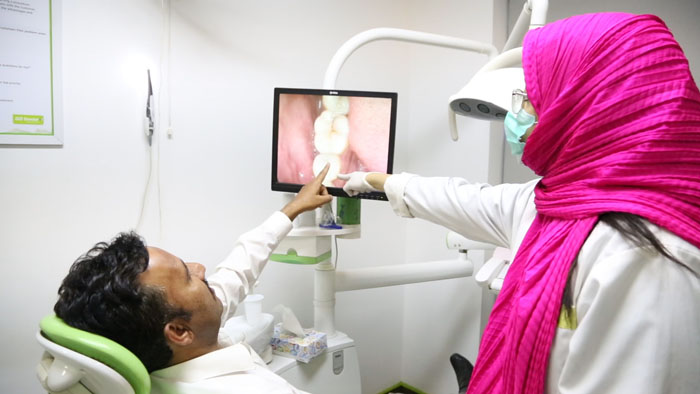
Digital X-ray, if needed. For a fuller picture, we may take a digital X-ray on the spot. It’s fast, low-dose, and the image is ready to review with you within minutes.

A clear plan, not a sales pitch. You’ll leave knowing exactly what (if anything) needs attention, what it involves, and what it costs — with zero obligation to book anything that day.

Both the consultation and the X-ray are completely free. The idea is simple: you shouldn’t have to pay just to find out what’s going on in your own mouth.

Categories
Uncategorized

Braces vs. Clear Aligners: Which Is Right for You?

Straightening your teeth used to mean one option: metal braces. Today, most patients are choosing between traditional braces, ceramic braces, and clear aligners — and the right choice depends on more than just looks.

Metallic braces are still the most affordable option and work well for complex bite corrections that need precise, continuous force. They’re fixed in place, so there’s no risk of forgetting to wear them.

Ceramic braces work the same way as metal braces but use tooth-colored brackets that blend in far more than metal does — a popular middle ground for patients who want less visible treatment without the aligner price tag.

Clear aligners (like our Clear Path® Invisible Aligners) are removable, nearly invisible trays that you switch out every couple of weeks. They’re generally the most comfortable option and let you eat, brush, and floss normally — but they only work if you’re disciplined about wearing them the recommended 20+ hours a day.

There’s no universal “best” option — it depends on your bite, your budget, and your lifestyle. The only way to know for sure is a proper assessment, which is exactly what your free consultation is for.

Categories
Uncategorized

1. 5 Signs You Might Need a Root Canal

Tooth pain has a way of showing up at the worst possible time — and it’s easy to brush off as “just sensitivity” until it isn’t. Here are five signs that it might be more than a passing ache.

Lingering sensitivity to hot or cold. A quick zing from ice cream is normal. Pain that lingers for 30 seconds or more after you finish eating or drinking is not — it often means the nerve inside the tooth is inflamed or infected.

A dull ache that won’t settle. Sharp pain gets your attention right away, but a constant, low-grade ache — especially one that throbs when you lie down — is just as worth checking out.

Swelling or tenderness in the gums. Swelling near a specific tooth, or a small bump on the gum that looks like a pimple, can be a sign of infection at the root.

Discoloration. A tooth that’s turned noticeably darker than the ones next to it can mean the tissue inside has been damaged.

Pain when you bite down. If chewing on one particular tooth is uncomfortable or painful, the nerve may already be compromised.

None of these on their own means you definitely need a root canal — but any one of them is a good reason to get looked at before it turns into an emergency. At Go Dental, every new patient starts with a free consultation and a digital X-ray, so we can tell you exactly what’s going on before any treatment begins.

Categories
Uncategorized

Behind the Scenes: How We Sterilize Every Instrument, Every Time

Hygiene in a dental clinic isn’t something you can see with the naked eye — you have to trust it’s happening. Here’s exactly what goes on behind the scenes at Go Dental before any instrument touches a patient.

Step 1 — Pre-clean. Every instrument is rinsed and manually pre-cleaned immediately after use to remove visible debris, before it ever reaches the sterilization area.

Step 2 — Ultrasonic cleaning. Instruments go through an ultrasonic cleaner, which uses high-frequency sound waves to dislodge anything a manual rinse might miss — including debris in hinges and narrow grooves that are impossible to scrub by hand.

Step 3 — Autoclave sterilization. Instruments are sealed in sterilization pouches and processed in a medical-grade autoclave, using high-pressure steam at a controlled temperature to eliminate bacteria, viruses, and spores — the same standard used in hospitals.

Step 4 — Sealed storage. Once sterilized, instruments stay sealed in their pouches until the moment they’re opened in front of you for your treatment — not before.

This process happens for every patient, every single time, with no exceptions. It’s not the most visible part of a dental visit, but it’s one of the most important — and it’s a big part of why we can promise clean, modern care at both our Tipu Sultan and Gulshan-e-Iqbal locations.

Categories
Uncategorized

Affordable Dentistry in Karachi: How Go Dental Keeps Quality Care Within Reach

“Affordable” and “quality” don’t always go together in dental care — but they don’t have to be a trade-off either. Here’s how we keep prices fair without cutting corners.

Free consultations and X-rays. You shouldn’t have to pay just to find out what’s wrong. Every new patient gets a full consultation and, when needed, a digital X-ray — completely free, with no obligation to proceed.

Transparent, upfront pricing. Every treatment on our price list is exactly that — listed, published, and the same for every patient. No surprise charges after the fact, and no pressure to say yes to add-ons you didn’t ask about.

Tiered options where it makes sense. Not every patient needs the most expensive version of a treatment. Whether it’s a basic cleaning or a full deep clean with gum care, or an economy versus a zirconia crown, we lay out the real differences so you can choose based on your needs and budget — not a one-size-fits-all recommendation.

Two convenient locations. Choosing between Tipu Sultan and Gulshan-e-Iqbal means less time and money spent traveling across the city for routine care.

Affordable dentistry, done properly, isn’t about doing less — it’s about cutting unnecessary costs, not necessary care. That’s the model we’ve built Go Dental around.